library(ggdist)

# Índice para junio 1 — igual que J_pred en el artículo Gaussiano
j_pred_fin     <- as.numeric(lubridate::ymd("2026-05-31") - min(encuestas_raw$fecha)) + 1L
cols_gauss_fin <- paste0("p_pred[", j_pred_fin, ",", 1:6, "]")

color_map_2026 <- tibble::tibble(
  cod        = cand_codes,
  color_cand = c(colores_2026[["ic"]], colores_2026[["adle"]],
                 colores_2026[["pv"]], colores_2026[["sf"]], colores_2026[["cl"]])
)

gauss_draws_fig <- arrow::read_parquet(
  gaussiano_path,
  col_select = dplyr::all_of(cols_gauss_fin)
) |>
  purrr::set_names(c(cand_codes, "ruido")) |>
  tidyr::pivot_longer(dplyr::everything(), names_to = "cod", values_to = "prop") |>
  dplyr::filter(cod != "ruido") |>
  dplyr::left_join(candidatos_2026_df, by = "cod") |>
  dplyr::left_join(color_map_2026,     by = "cod") |>
  dplyr::group_by(cod) |>
  dplyr::mutate(candidato_m = mean(prop)) |>
  dplyr::ungroup()

nombre_orden_2026 <- gauss_draws_fig |>
  dplyr::distinct(cod, candidato_m, nombre) |>
  dplyr::arrange(candidato_m) |>
  dplyr::pull(nombre)

gauss_draws_fig |>
  dplyr::mutate(nombre = factor(nombre, levels = nombre_orden_2026)) |>
  ggplot2::ggplot(ggplot2::aes(x = prop, y = nombre)) +
  ggdist::stat_dist_slabinterval(
    ggplot2::aes(
      fill      = color_cand,
      fill_ramp = ggplot2::after_stat(level)
    ),
    .width         = c(0.5, 0.8, 0.95, 0.99),
    interval_alpha = 0.95,
    show.legend    = c(fill = FALSE, fill_ramp = TRUE, size = FALSE)
  ) +
  ggdist::stat_pointinterval(
    ggplot2::aes(label = scales::percent(candidato_m, accuracy = 0.1)),
    geom   = "label",
    .width = 0,
    vjust  = -0.5,
    fill   = "white",
    color  = "black"
  ) +
  {
    res_fig <- resultados_2026 |>
      dplyr::rename(nombre = candidato) |>
      dplyr::left_join(
        dplyr::left_join(candidatos_2026_df, color_map_2026, by = "cod") |>
          dplyr::select(nombre, color_cand),
        by = "nombre"
      ) |>
      dplyr::mutate(
        nombre    = factor(nombre, levels = nombre_orden_2026),
        y_num     = as.numeric(factor(nombre, levels = nombre_orden_2026)),
        resultado = resultado / 100
      )
    list(
      ggplot2::geom_segment(
        data = res_fig,
        ggplot2::aes(
          x = resultado, xend = resultado,
          y = y_num - 0.4, yend = y_num + 0.4,
          color = color_cand
        ),
        linewidth = 2.5, inherit.aes = FALSE
      ),
      ggplot2::geom_label(
        data = res_fig,
        ggplot2::aes(
          x     = resultado,
          y     = y_num + 0.6,
          label = scales::percent(resultado, accuracy = 0.1),
          fill  = color_cand
        ),
        color         = "white",
        size          = 5,
        fontface      = "bold",
        label.size    = 0,
        label.padding = ggplot2::unit(0.25, "lines"),
        inherit.aes   = FALSE
      ),
      ggplot2::scale_color_identity(guide = "none")
    )
  } +
  ggplot2::scale_x_continuous(
    labels = scales::percent_format(accuracy = 1),
    expand = expansion(mult = c(0.05, 0.15))
  ) +
  ggplot2::scale_fill_identity(na.translate = FALSE) +
  ggdist::scale_fill_ramp_discrete(
    name   = "Intervalo creíble",
    range  = c(0.25, 1),
    breaks = c(0.5, 0.8, 0.95, 0.99),
    labels = c("50%", "80%", "95%", "99%"),
    na.translate = FALSE
  ) +
  ggplot2::labs(
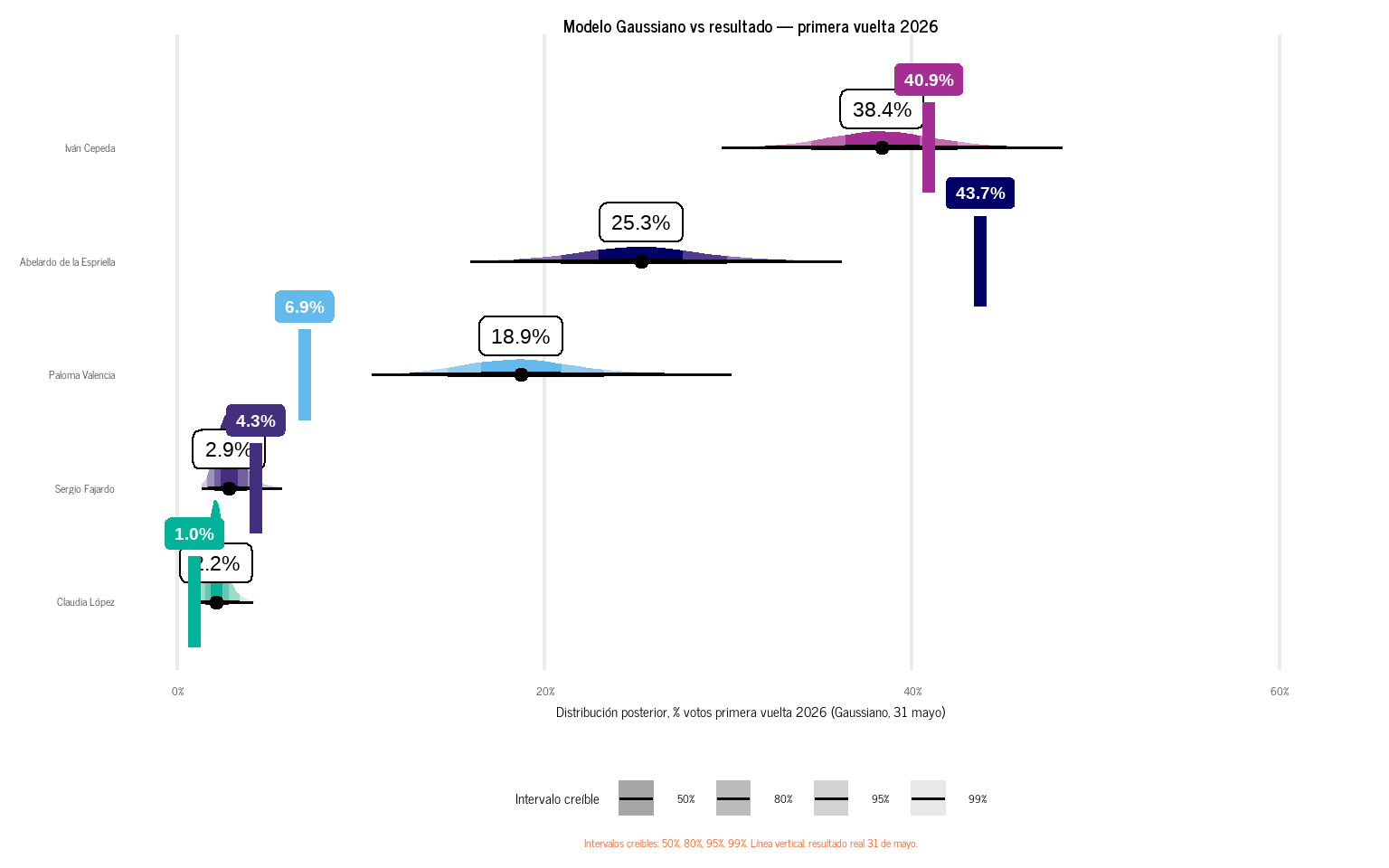
    x       = "Distribución posterior, % votos primera vuelta 2026 (Gaussiano, 31 mayo)",
    y       = NULL,
    title   = "Modelo Gaussiano vs resultado — primera vuelta 2026",
    caption = "Intervalos creíbles: 50%, 80%, 95%, 99%. Línea vertical: resultado real 31 de mayo."
  ) +
  theme_recetas(base_size = 16) +
  ggplot2::theme(
    panel.grid.major.y = ggplot2::element_blank(),
    panel.grid.minor   = ggplot2::element_blank(),
    legend.position    = "bottom"
  )